Wednesday, 12 December 2018

Professional Peripheral Biofeedback BCIA Program

Training Dates and Locations

Continuing Education Credit Available

Health Training Seminars, a division of Biofeedback Resources International is approved by the American Psychological Association to sponsor continuing education for psychologists. Health Training Seminars maintains responsibility for this program and its content.

BCIA Certification Requirements

A good link for Travel Arrangements

Professional Peripheral Biofeedback BCIA Program


JAN 17-19, 2019 – Miami, FL
May 3-5, 2019 – Hawthorne, NY
June 22-24, 2019 – Houston, TX
July 19-21, 2019 – Hawthorne, NY

Price: $1195

Our new style of seminar is designed to teach clinicians biofeedback fundamentals and cutting-edge applications. For better use of your time, the seminar will be a combination of 3-day classroom, home study and web-based training.

BRI Seminars Registration Form

Send payments to:

Biofeedback Resources International

109 Croton Ave, 2nd Fl, Suite 240

Ossining, NY 10562-5102

FAX: 914-762-2281

Please fill out the following and return. Print all information
Name as you would like it for the certification with any initials or credentials

Registration Form Click Here

Professional Peripheral Biofeedback BCIA Program

This innovative seminar is designed to teach clinicians biofeedback fundamentals and cutting-edge applications. This program covers all 48 hours of the BCIA Didactic Biofeedback Education requirement through powerful demonstrations of biofeedback and adjunctive procedures, imaginative hands-on lab exercises with multi-channel computerized equipment, professional multimedia presentations and comprehensive review materials. This program integrates personal hands-on training with equipment with didactic presentation.

Participants will learn:
    • The foundations of biofeedback

    • Physiological basis and recording of surface electromyography (sEMG), temperature, electrodermal activity (EDA), respiration patterns (strain gauges and pCO2), electroencephalography (EEG), peripheral blood flow (BVP), heart rate and respiratory sinus arrhythmia (RSA) and economic biofeedback approaches (including incentive inspirometers and scales)

    • How to identifying artifacts and determining appropriate recording

    • How to record and interpret data

    • How to perform a psychophysiological profile and pre and post data comparison

    • The use of adjunctive techniques such as progressive relaxation t raining, autogenic training, imagery, guided breathing, desensitization, mindfulness training, quieting reflex.

    • The role of home biofeedback devices such as Freeze framer, Wild Divine and GSR2

    • Overview of clinical and educational applications

 Event Info: Biofeedback Equipment

Tuesday, 11 December 2018

How do I build a successful Biofeedback practice?

A personal sense of mission is the best foundation upon which to build success. Such a sense of mission about biofeedback may not be so hard to achieve because the tools which reduce suffering and enhance self knowledge are surely technology at its highest. Therefore, the better your training and equipment the quicker you will integrate this scientific art form with your own therapy style, the deeper will be your inspiration and the greater your enthusiasm. "Nothing of importance can be accomplished without enthusiasm." Emerson

There are two fundamental considerations:
  1. Acquiring the correct equipment and training.
  2. Making the economic aspects of your practice work.
The Economics Of Biofeedback
 
Some of our clients are so economically sophisticated that we consult with them so we can pass their expertise on to those who need it. However, many health care professionals need assistance in developing the business side of this science and art. General business knowledge for this field is relatively easy to come by, and we usually cover it in our seminars and with clients who acquire equipment from us. However, the most successful practices go beyond general economics to the acquisition of specific information that allows them to maximize their unique circumstances. Our consulting services meet this need and those who have used them report a high return on their investment. Biofeedback practices range from small adjunctive services comprising a small percentage of a particular health care enterprise to multi million dollar profit centers. Whatever your goals in this area, we can help you get there. Obviously, you can call us and we will answer questions for you until you feel you can make the best decisions for your circumstances.


Wednesday, 5 December 2018

What is the Biofeedback Certification Institute of America?

The Biofeedback Certification Institute of America (BCIA) was created in January 1981 to establish and maintain standards for practitioners who use biofeedback, and certify those who meet these standards. BCIA is an autonomous nonprofit corporation. Its primary mission is to protect the public welfare by assuring the competence of certified biofeedback practitioners. BCIA policies and procedures are determined by an independent board which is comprised of a rotating group of distinguished biofeedback clinicians and researchers.

In 1996 the Board of Directors of the Biofeedback Certification Institute of America and the Academy of Certified Neurotherapists collaborated to develop a specialty certification in EEG Biofeedback to be managed and administered by BCIA. The opportunity to certify through the grand parenting process ended on December 31, 1997. As of 1998 the formal certification program in EEG Biofeedback is underway. In 2004 certification in Pelvic Muscle Dysfunction was added.

Thursday, 29 November 2018

Quick & Easy Stress Reduction Solutions – Part 4

In my last article I talked about how we can use our breathing to help us relax.  Here is the link my blog page where that article is if you missed it:  https://biofeedbackinternational.com/blog/

Here I will talk about another powerful relaxation tool that you can use with or without any physical tools.  Muscle relaxation is another tool you can use to quickly and easily relax.

Stress Reduction Solution #4 is Using Muscle Relaxation to Reduce Stress Book


We represent stress in our muscles.  As a reaction to stressful events we tend to contract our muscles and hold some excess tension in our muscles chronically.  This can lead to problems.

Muscles are intended to contract to either to cause movement of our body or to maintain posture.  A certain amount of muscle contraction is necessary to maintain posture so that you don’t fall over.  Additional contraction is necessary to move a part of your body.  Once the movement is over the muscle is supposed to go back to a resting state.

Muscles also contract in reaction to stress as part of the fight or flight response.  This is a normal reaction which is intended to prepare your body to respond physically to an emergency.   This is very helpful if there really is an emergency that requires a physical reaction like if a car jumped onto the sidewalk and you have to run for your life.  The extra tension in your muscles would allow you run faster, jump higher, and hit harder.  This reaction might save your life in a real emergency.

Here is the problem, your nervous system doesn’t tend to be smart enough to not react in the same way when you have a problem at work or you get stuck in traffic.  Your muscles contract as though you had to run, jump, or fight.  Since it is not necessary to react physically, that extra tension is not useful.  In many cases at least some of the extra tension doesn’t go away meaning that the muscles stay partially contracted for no useful reason.  When the muscles don’t go back to a resting state it can lead to pain.  The constant muscle contraction can also continue to send signals to the brain and nervous system to stay in an emergency mode which can cause you to feel stressed or anxious.  It can also be physically draining because the muscles are using resources and energy to maintain the contracted state.


Official Web Site: Best Stress Books | Reduce Your Stress

More Info: Manage Stress Without Drugs Or Alcohol

Wednesday, 28 November 2018

Professional Peripheral Biofeedback BCIA Program

Professional Peripheral Biofeedback BCIA Program

Training Dates and Locations

Continuing Education Credit Available

Health Training Seminars, a division of Biofeedback Resources International is approved by the American Psychological Association to sponsor continuing education for psychologists. Health Training Seminars maintains responsibility for this program and its content.
BCIA Certification Requirements

Professional Peripheral Biofeedback BCIA Program

JAN 17-19, 2019 – Miami, FL
April 12-14, 2019 – Hawthorne, NY
June 22-24, 2019 – Houston, TX
July 19-21, 2019 – Hawthorne, NY

Price: $1195

Our new style of seminar is designed to teach clinicians biofeedback fundamentals and cutting-edge applications. For better use of your time, the seminar will be a combination of 3-day classroom, home study and web-based training.

BRI Seminars Registration Form

Send payments to:

Biofeedback Resources International
109 Croton Ave, 2nd Fl, #5

Ossining, NY 10562-5102

FAX: 914-762-2281

Please fill out the following and return. Print all information
Name as you would like it for the certification with any initials or credentials

Registration Form Click Here

Professional Peripheral Biofeedback BCIA Program

This innovative seminar is designed to teach clinicians biofeedback fundamentals and cutting-edge applications. This program covers all 48 hours of the BCIA Didactic Biofeedback Education requirement through powerful demonstrations of biofeedback and adjunctive procedures, imaginative hands-on lab exercises with multi-channel computerized equipment, professional multimedia presentations and comprehensive review materials. This program integrates personal hands-on training with equipment with didactic presentation.

Participants will learn:
    • The foundations of biofeedback
    • Physiological basis and recording of surface electromyography (sEMG), temperature, electrodermal activity (EDA), respiration patterns (strain gauges and pCO2), electroencephalography (EEG), peripheral blood flow (BVP), heart rate and respiratory sinus arrhythmia (RSA) and economic biofeedback approaches (including incentive inspirometers and scales)
    • How to identifying artifacts and determining appropriate recording
    • How to record and interpret data
    • How to perform a psychophysiological profile and pre and post data comparison
    • The use of adjunctive techniques such as progressive relaxation t raining, autogenic training, imagery, guided breathing, desensitization, mindfulness training, quieting reflex.
    • The role of home biofeedback devices such as Freeze framer, Wild Divine and GSR2
    • Overview of clinical and educational applications

 Official Website: Behavioral Health Seminars

More Event Info: Biofeedback Instruments

Monday, 26 November 2018

Mindfield® eTemp | APA continuing Credits

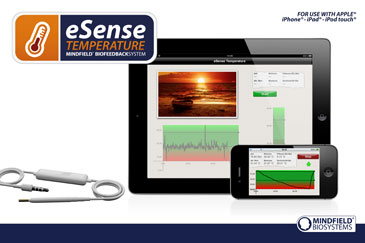
The eSense Temperature is a small sensor for measuring your skin temperature with the microphone input of your smartphone or tablet (Android or Apple iOS.)

A free app by Mindfield® is included to display your skin temperature in different ways for biofeedback training. You can export the measured values via e-mail.

Handwarming training is an especially effective and common biofeedback method. The temperature of our hands is connected to our stress level: When we are stressed, we tend to have cold hands.

 The eSense Temperature sensor is attached to your index or middle finger, or held between index finger and thumb. Immediate feedback enables you to voluntarily increase the skin temperature in your fingers, thus increasing your peripheral blood circulation, leading to relaxation and stress reduction.

This is an easy and effective training to improve your well-being!

Background information on Skin Temperature


The skin’s surface temperature changes according to blood circulation through body tissue. The small blood vessels (arterioles) crossing through the tissue are surrounded by fibers of smooth muscle controlled by the sympathetic nervous system.

In a state of increased exertion, excitement and stress, these muscle fibers contract and narrow the blood vessels. This leads to a reduction of skin temperature because blood circulation through the tissue is reduced. By contrast, in a resting or calm state, the muscles relax and the blood vessels expand. The skin temperature rises.

Official Website: APA continuing Credits

More Info Click Here : APA continuing training 

Friday, 23 November 2018

Quick & Easy Stress Reduction Solutions – Part 3

Sometimes you don’t have anything with you, no essential oils, no smart phone with relaxation app or relaxation music or biofeedback instrument.  You may not be able to go outside for a nice walk or sit by the lake to relax.  You could be in an office on the 25th floor or in the subway feeling stressed.  What can you do to relax now?

In my previous article I talked about how spending time in nature can reduce stress and I shared a free relaxation video link.  To read that article and view the video click on this link: https://biofeedbackinternational.com/quick-easy-stress-reduction-solutions-part-2/#more-3637

Today we will discuss how breathing can be used relax.

Stress Reduction Solution #3 is Breathing to Relax
Since you were born you have been breathing.  If you believe in God and creation, when God created man He breathed into his nostrils the breath of life and then man became a living soul.  When you stop breathing, you stop living.  So breathing is important, right? If breathing is so important then how you breathe might also be important.  Have you ever heard someone tell you to take a deep breath when you were upset about something?  You may not have believed them.  In fact you may have wanted to tell them to shut up or worse.  What if I told you that it can be shown scientifically that changing your breathing can directly affect your nervous system and change the activity of your heart.  The effect is measureable.  We can measure the changes in your heart rate and heart rate variability pattern when you change your breathing.  There are professional and home devices that can be used to show this.  Some of them connect to PCs, Mac computers, and smart phones and tablets.  These devices are very helpful for doing diaphragmatic breathing training because you can see the measurements of what you are doing and the responses that your heart has when you change your breathing.  There are also biofeedback sensors that measure your breathing.  A belt goes around your abdomen which stretches when you inhale and then goes back to normal when you exhale.  It measures how deep you are breathing and how fast you are breathing (breaths per minute).  Again, they are very helpful.  If you want to learn more about these devices and where to get them contact me.  What I want to do here is show you how you can use breathing exercises to calm and relax yourself quickly where ever you are.

Although our brain automatically monitors and regulates our breathing so that we don’t have to think about it, we do have the ability to override that control and change our breathing pattern.

Official Website: Stress Minimizing Books

More Info: Popular Stress Management Books